
MVP Demo: StarMiners
- Genre: 3D Exploration/Farming Game
- Type: MVP - Demo
- Engine: Unreal Engine 5
- Role: Game | Level | Narrative Designer
- Studio: Independent Production
Goal

Pitched as “Dave the Diver meets Deep Rock Galactic,” Star Miners is a cozy co-op space mining adventure built around resource gathering, a narrative HUB, and a relaxed co-op experience.
- Document the core game loop and systems in a 40+ page GDD within production constraints.
- Design a social HUB level balancing narrative depth, player flow, and 4-player scalability.
- Apply game design skills in a professional pipeline alongside industry veterans.
Working within a team of around 15 people on a project developed with the intent to pitch to publishers, this project bridged academic game design and professional industry practice.
Overview
Setting: Star Miners takes place in “Starminer’s Reach,” a remote, myth-soaked solar system on the galactic rim. Players arrive at The Driftwood, a salvaged dreadnought converted into a gritty, neon-lit spaceport and social HUB, as independent prospectors chasing the legend of Pandora’s Vault, a hidden motherlode rumored to make its finder the richest person in the galaxy.
Constraint: This MVP was developed in 45 days by a team of around 15 people with the intent to pitch to publishers, covering both The Driftwood HUB and a space mining sequence.
Design Pillars:
The “One More Run” Loop: The core Mission > Mine > Return > Upgrade loop is designed to always give players a clear and achievable next goal.
Rewarding Exploration: Danger comes from the environment, not combat. Oxygen management and navigational challenges make exploration feel meaningful and tense.
Narrative & Tone in Everything: The “cozy sci-fi sarcasm” tone inspired by Futurama is embedded in every asset, from NPC dialogue to item descriptions and environmental storytelling.
Strength in Unity: The Driftwood functions as a living social space, not just a menu, anchoring the player experience between expeditions.
My Contributions
Game Design Document: Authored the foundational GDD solo under the direction of the project lead, establishing the systems and vision the entire team built from.
- 40+ pages covering core loop, systems, narrative, and world design
- Authored solo but shaped through continuous collaboration with the broader team
Level Design: Designed the Driftwood HUB from a technical test proposal to the final MVP layout.
- Proposal approved and adopted as the official starting point for production
- Iterated through multiple layout versions balancing atmosphere, flow, and 8-player scalability
Narrative & Dialogue: Wrote all narrative content for the MVP, from the main questline to environmental flavor text.
- Complete MSQ across 2 key NPCs
- 4 ambient Barks adding world context throughout the HUB
Blueprint Scripting: Supported implementation by building on existing systems as a prototype foundation.
- Connected UI interactions using the StoryFramework plugin
- Prototyped simple mechanics on top of existing blueprint infrastructure
Highlights
Driftwood (Main Hub)
The Driftwood is the social anchor of Star Miners, designed so that the moment the player enters, the space communicates its hierarchy, tone, and purpose without a single UI marker.
Atmosphere First: The dense, neon-lit layout immediately establishes the “cozy sci-fi sarcasm” tone, signaling to the player that this is a place to breathe between high-tension expeditions.
Spatial Storytelling: Architectural framing and NPC placement create an implicit social hierarchy, naturally directing player attention to key narrative interactions from the moment of entry.
Dialogue
The entire MVP script was written to make onboarding feel like entertainment, using a “Workplace Sci-Fi” sarcasm inspired by Futurama to keep players engaged while learning the core mechanics.
- Comedy as onboarding: Every functional quest step was wrapped in cynical, character-driven dialogue that made the tutorial loop feel like a story worth following. Player choices add flavor and characterization without branching the narrative, keeping implementation scope manageable.
Quest Flow

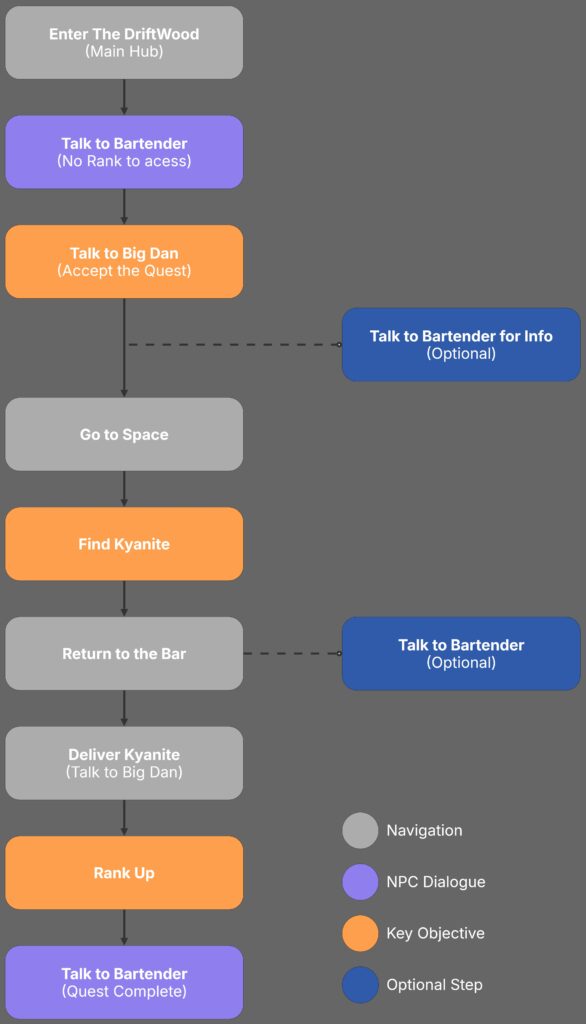
The MSQ was designed and mapped in Miroboard before implementation, covering the complete flow from the player’s first interaction to quest completion across 2 key NPCs.
End-to-end ownership: Responsible for the full pipeline, from writing the dialogue and quest structure to implementing it in Unreal Engine 5 using the StoryFramework plugin.
Structured design first: Mapping the flow in Miroboard before scripting ensured the quest logic was validated before touching the engine, reducing implementation issues.
- Collaborative foundation: Built the quest structure and dialogue on top of the narrative framework established by the Narrative Lead, ensuring the MSQ stayed consistent with the broader story direction.
Techniques
Visual Hierarchy
Big Dan is placed at the center of the seating area on an elevated platform, making his social dominance readable the moment the player enters.
Framing: Central position and elevation establish authority through geometry alone.
No UI needed: Social hierarchy is communicated before any dialogue occurs.
Player direction: The most important NPC is instantly identifiable without markers.
Flow Optimization
The open-plan layout keeps all key interaction points visible and reachable from anywhere in the bar, minimizing travel time on repeat visits.
Frictionless loop: No obstacle, the player moves directly to their next objective.
Repeat-visit design: A HUB visited hundreds of times must never feel like a chore to navigate.
Visibility: Bar, Big Dan, and exit are all readable from a single vantage point.
Barks
Non-interactable NPCs deliver world context through proximity-triggered flavor text, adding narrative depth without interrupting the main quest flow.
Tone reinforcement: Each line reflects the bar’s “cozy sci-fi sarcasm” tone, making the world feel lived-in.
Zero friction: Players absorb lore naturally by moving through the space, with no forced stops.
Low cost, high impact: side-NPCs expand the world without additional quest design resources.
Case Study: Test Level
The Brief
Design a blockout for a 1-8 player social HUB in a grungy, neon-lit sci-fi setting.
Requirements:
Accommodate specific features: Bar, Dance Floor, Jukebox, and Mini-games
Support 8-player scaling
Integrate narrative elements
Constraints:
Adhere to provided Concept Art (rounded shapes, central bar)
Create a functional loop for frequent player visits
Core Concept
Inspired by Dave the Diver’s bar restoration loop, I proposed a “Under Construction” HUB inside a hollowed-out asteroid. Rather than a static, fully-finished space, the bar starts semi-destroyed and physically expands as the player progresses.
Design Intent: Expansion is spatial, not just cosmetic. Players unlock new physical areas of the HUB, making progression visible and tangible in the space itself.
Narrative Hook: The opening quest becomes “fix your home” rather than “go fetch,” creating personal stakes before the player has invested any time in the world.

Concept Art Reference: Original artwork by Jakub Nowak.
Layout Strategy & Iteration
I initially considered a vertical layout (Ground Floor: Bar, Basement: Party, 1st Floor: Arcade).
Why it failed: It segmented the player base too much and increased friction. For a Hub that players visit hundreds of times, navigation must be frictionless. Forcing players to change floors just to find a merchant would become tedious.
Selected Layout (The “Open Flow” Plan): I opted for a centralized, open-plan layout inside a crashed ship/asteroid.
Flow Philosophy: “Interaction-Oriented.” Key loop elements (Hangar -> Bar -> Boss -> Upgrade) are arranged to minimize travel time.
Scalability: Designated “Construction Zones” allow the geometry to expand visually as the player progresses, without cluttering the initial “Newbie” experience.


Blockout Decisions & Spatial Logic
A. Visual Hierarchy (The “Boss” Room)
Decision: I placed the Quest Giver/Boss in a glass room on the 2nd floor, overlooking the entire bar.
Rationale: This creates an immediate visual landmark. Even without a UI marker, a new player instinctively knows that the “important person” is the one supervising the area from above. It establishes authority and hierarchy through geometry.

B. The Central Bar (Adhering to Art Direction)
Decision: Kept the bar island in the center of the room.
Rationale: While a wall-bar creates more open space, the Concept Art dictated a central bar. I respected this constraint but ensured wide pathways around it to prevent player collision bottlenecks in an 8-player session.

C. Narrative Placement
The Conspiracy Android: Placed in a dark corner, isolated from the main flow. (Fits the “paranoid” archetype).
The Drunk Miner: Seated by a window looking out at the void. (Reinforces the narrative of a “past-his-prime” veteran longing for the old days).

Miro Board: Detailed Process
Case Study: MVP Level
From Technical Test to MVP
The Technical Test proposal, originally called “Nebula Tap,” was selected as the foundation for the official MVP production pipeline, now renamed “The Driftwood.” The core layout concept carried forward directly into production.
These three major direction shifts shaped the transition:
Aesthetic pivot: The visual direction moved from clean sci-fi to a grittier “Dive Bar” atmosphere, directly impacting the size and layout of the space.
Concept cut: The “Under Construction” meta-game was removed as the project shifted focus from player investment in the bar to a pure social HUB experience.
Scope reduction: The exterior docking area was cut due to time and resource constraints, focusing the MVP strictly on the interior social experience.
The Scoping Challenge: Finding the Right Size
Scaling the space up by ~40% to accommodate 4 players created an immediate conflict:
Larger space exponentially increased the Art team’s workload, threatening the 45-day timeline
Larger space killed the Dive Bar atmosphere the game required
The answer was not a bigger bar, it was a denser one. Finding that balance required 9 2D layout variations before the final footprint was approved by the Art Director and Game Director.


A. Spatial Exploration
Testing how geometry shapes player behavior and perception:
Polygon shapes (hexagons) to break the rectangular grid and add a futuristic, organic feel
Floor level variations to create visual hierarchy without vertical navigation
Entry point positions to control the player’s first read of the space


B. Element Placement
Testing how NPC and feature positioning communicates social hierarchy:
Bartender framing as the primary interaction anchor upon entry
Big Dan positioning to communicate dominance without dialogue
Boss Room visibility as a natural quest waypoint from the main floor
Key Design Decisions
After 9 layout variations, the approved footprint confirmed that simplicity serves a Dive Bar better than complexity, returning to the same open layout principle that defined the Technical Test.
Validated by iteration: 9 increasingly complex variations ruled out what did not work, making the case for restraint through evidence rather than assumption.
Four decisions defined the final space: bar size and format, central bar placement, NPC positioning, and the second floor as a narrative device.
A. Simplicity
The layout evolution followed three clear stages:
Technical Test: Simple rectangular layout, clean and open, but larger and with a more futuristic feel.
MVP Exploration: 9 variations testing hexagons, irregular polygons, and mixed geometries in search of something that felt more fitting for a space bar.
Final Layout: Back to a rectangle, now smaller and denser, with the complexity stripped away in favor of Dive Bar atmosphere and frictionless navigation.


B. Central Bar
Moving the bar from the center to the wall was a deliberate decision to improve both flow and first impression:
Immediate PoI: The bar is the first element the player sees upon entering, establishing it as the primary interaction anchor without competing with the rest of the space.
Unobstructed flow: A wall-mounted bar keeps the floor open, preventing navigation bottlenecks in an co-op session.
Full visibility: Players can read the entire space from the entrance, reducing disorientation on first visit.

C. Key NPC Placement
Every NPC position was defined by their role and relevance to the MVP experience, using spatial placement to communicate social hierarchy and narrative importance without UI markers.
The Bartender (The Anchor):
Placement: Centrally located and framed by the architecture.
Intent: Upon entering, the player’s eye is immediately drawn to the Bartender, establishing them as the primary interaction point for quests and lore.

“Big Dan” (The Power Figure):
Placement: Occupying the central table in the seating area.
Intent: By placing him in the most prominent spot of the “social zone,” we visually communicate his importance and dominance in the local hierarchy. He physically “owns” the room.

The Enigma Woman (The Mystery):
Placement: Seated at the bar, adjacent to the Bartender’s interaction point.
Intent: Always visible in high-traffic areas but never interactable, her position shifts slightly on each visit. This signals to attentive players that she matters, building curiosity about her role before her narrative arc begins.

D. Second Floor
A second floor is a natural extension of the Dive Bar reference: small footprint, vertical growth. In the Technical Test it housed the Boss Room, using elevation to communicate authority. In the MVP, that same logic expanded into a social concept.
From boss to community: What was a single authority figure overlooking the bar became an entire exclusive social space, applying the same elevation principle at a broader scale.
Experience gate: Access requires in-world progression, turning inaccessibility into a tangible goal.
Future content hook: New NPCs, quests, and stories waiting above give players a reason to return.


Narrative Design
As a Game Designer, I approached the Star Miners script the same way I would approach any system: with clear intent behind every decision, inspired by the dry, sarcastic humor of Futurama.
Every dialogue line was designed to serve a specific function: establishing character, delivering a tutorial beat, or landing a comedic punchline
Design Intent was documented for every line in a structured spreadsheet
The result was a complete MSQ arc across 2 key NPCs, a 4-option optional lore loop, and 4 ambient Barks, all written to reinforce that Futurama-inspired tone throughout the MVP.
A. Narrative Arc
A rookie pilot tries to order a drink, gets blocked by the “Big Dan Mandate,” completes a dangerous fetch quest, and discovers their reward is a glass of unfiltered water the Bartender cannot dispense.
Setup: Bartender blocks the player, introducing Big Dan before any direct interaction
Conflict: Big Dan sends the player to the Artemis field to retrieve Kyanite
Resolution: Player delivers the ore and earns the title of “Scrum-Scraper”
Twist: The reward is unfiltered water the Bartender’s current build cannot dispense
Tone: Every onboarding step is wrapped in a comedic beat, establishing the Futurama-inspired humor from the first interaction
B. Design Decisions
Every dialogue line was written with a specific intent, using comedy as the primary delivery mechanism for three goals:
Character establishment
Tutorial information delivery
World tone consistency
Player Characterization
Every beat offers 3 choices that define the player’s tone without branching the narrative, keeping implementation scope manageable.
Neutral: “Uh… okay. So, what do you have?”
Aggressive: “Just the menu, tin can.”
Enthusiastic: “Bring me your finest drink, robot!”
Comedy Timing & Twist
The Bartender’s robotic processing beats (“Scanning…”, “Processing…”) create comedic pauses that build anticipation before every punchline.
In-fiction: The Bartender cannot dispense the reward
Meta: “Current build” refers simultaneously to the robot’s programming and the game’s MVP state
C. Dialogue Document
The complete MSQ script was written and structured in a spreadsheet, with each line documented across six key elements. This format validated the narrative logic before implementation and served as a clear reference for the development team.
Quest Stage: Tracks where each line sits within the quest flow
Character: Identifies the speaker and their role in the scene
Player Choice: Labels each available player option within a given exchange.
Line Type: Distinguishes between main quest lines, optional content, and barks
Design Intent: Documents the specific narrative and design purpose of each line
Next ID: Controls flow deviations such as loops and conversation exits