
PoE2 Crafting: Reimagined
- Genre: Action RPG
- Platform: PC (Steam)
- Type: System Design
- Role: Game Designer
- Status: Case Study
Overview
In Path of Exile 2, an action RPG, much of a character’s power comes from gear, and players make that gear stronger through crafting. They spend currency on an item, and each use adds or changes one of its bonuses at random.
I started this project while playing patch 0.5 of the game’s Early Access, a version in active development. My frustration came from doing everything right and still having little chance of getting the result I wanted. For most of my progress, character growth was at the mercy of chance.
The odds show how deep that luck runs. One of the most wanted bonuses for a spellcaster is +3 to the level of all spells on an amulet, and each random roll has about a 1 in 1,000 chance of landing it. That means close to a thousand tries on average, and the unluckiest 1% of players need more than 4,400.
My redesigned system shifts that balance from luck toward control. Players choose what they want and how far to push it, with every failed attempt raising the odds of the next one. With the same odds, that safety net alone brings the unluckiest 1% down from more than 4,400 tries to about 2,300.
Luck keeps a role and gives each roll its tension. Every item drops with a set Integrity that caps what it can hold. The strongest results need a rare base, which keeps good finds exciting.
Three versions shaped the design, each reviewed with a mentor, and a playable simulator is linked from this page.
Inside the design
- A crafting flow where players pick the bonus and the tier they aim for
- Limited room on every item to keep top-tier gear rare
- Eight groups of bonuses, with simple ones for new players and riskier ones for veterans
- Single-use items that bend one rule of a craft
- A playable simulator with every system above
Design Process
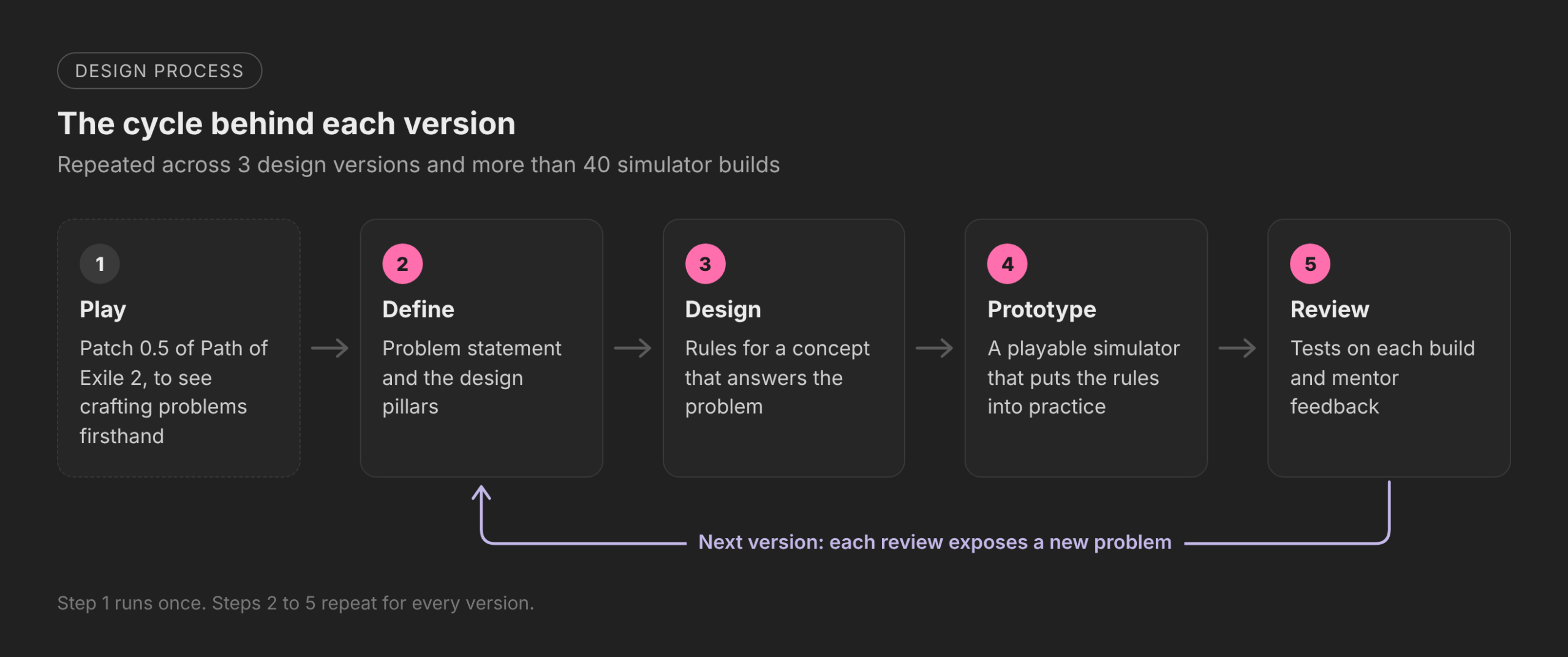
I built this design across 3 versions and more than 40 simulator builds. Each version followed the same cycle, closing with a review from my mentor. Those reviews exposed the next problem to solve.
The cycle
Play: patch 0.5 of Path of Exile 2, to see crafting problems firsthand.
Define: a problem statement plus the design pillars that guide every decision.
Design: rules for a concept that answers that problem.
Prototype: a playable simulator that puts those rules into practice.
Review: tests on each build, mentor feedback, then a return to step 2.
Version 1: full control
Players could pay to raise their odds with a dial, up to a guaranteed result. On paper it solved the luck problem. Building it showed that certainty also removed the reason to craft.
Bought results felt unearned.
With only one correct setting on the dial, each choice became a calculation.
Version 2: luck with a safety net
Without the dial, each attempt went back to spending one orb, a crafting currency, on a random result. A miss now raised the chance of the next hit, which kept luck in play while limiting bad streaks.
Deciding when to stop became the choice players face most often.
Aiming for stronger results started to cost rarer orbs.
Given enough attempts, any modifier could still reach its strongest version. A perfect item came down to time spent.
Version 3: limits on the item
Integrity entered the design as a limited amount of room each item has for modifiers. Stronger modifiers take more of that room, which means the item a player finds sets how far it can go.
Players now reach a ceiling set by the item, while regular crafts never destroy it.
Four new modifier pools arrived, along with Omens. Both used the same crafting loop, a first sign that new content could join the design without changes to its base rules.
Crafting in Patch 0.5
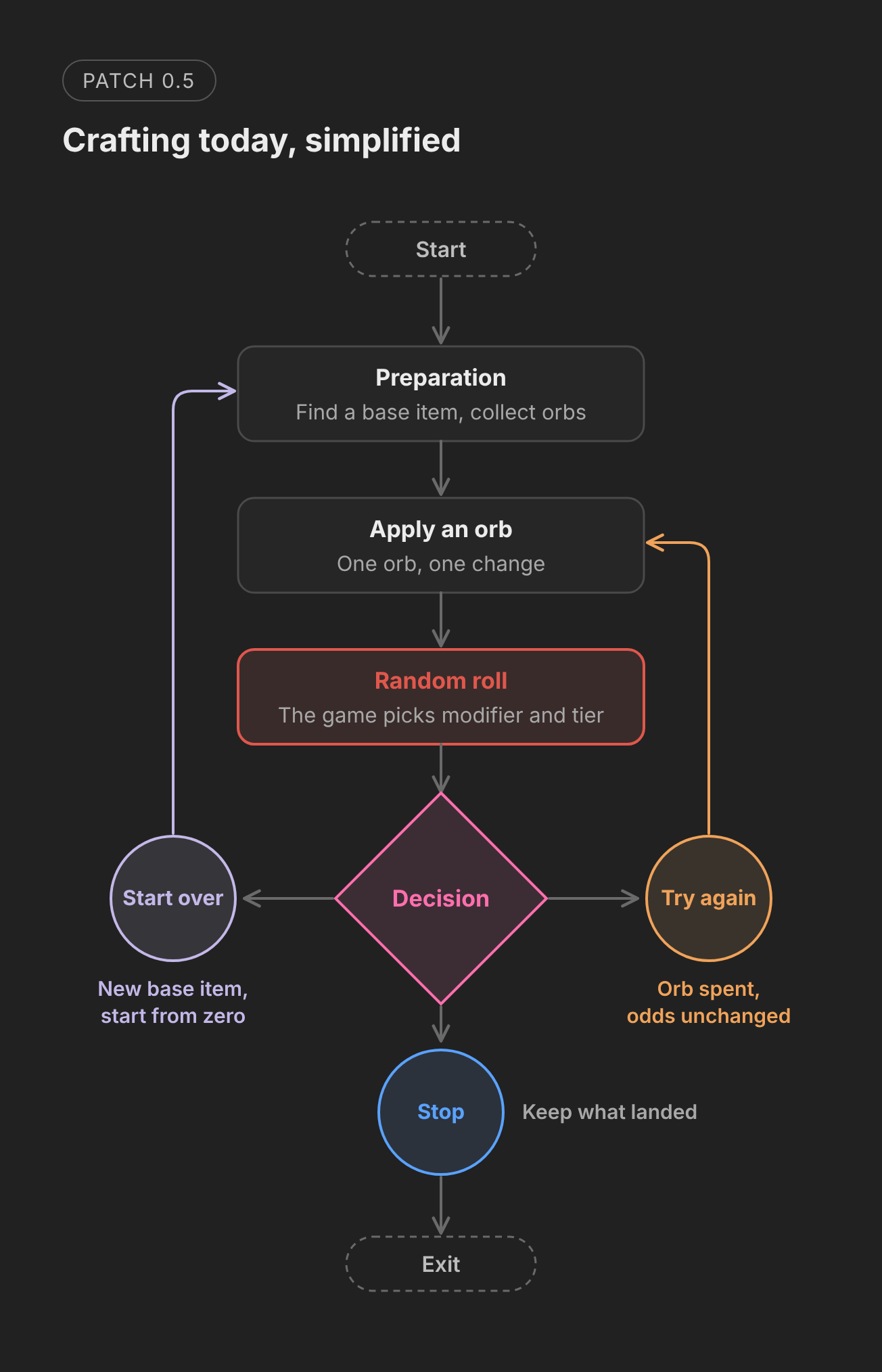
Before looking at my redesign, it helps to see how crafting works in the current game, patch 0.5, in its simplest form.
Five terms cover the basics.
Key terms
- Base item: a piece of gear with no bonuses yet, such as a ring or a body armour.
- Modifier: one bonus line on an item, such as “+40% to Fire Resistance”. A rare item can hold up to six.
- Tier: how strong a modifier is. Tier 1 is the strongest, and also the rarest to roll.
- Item level: a number on every item that limits which tiers it can roll. The best tiers need high-level items.
- Currency: single-use orbs spent to change an item. Each orb has one job: adding, replacing or removing a modifier.
How crafting works today
- Preparation: Players find a base item and collect currency, mostly by defeating monsters. This is the planning step, and in 0.5 it is also where most of their control ends.
- Apply an orb: They pick an orb and use it on the item. An Exalted Orb adds one new modifier.
- Random roll: The game then picks which modifier appears and at which tier. Strong tiers are weighted to be rare, which leaves most results weak or useless for the character.
- Decision: Players keep the result, spend another orb to try again, or start over with a new base item. Every orb is consumed either way, and a failed try leaves no progress behind.
Later in the game
This loop is the simplified version players meet early on. In the late game, Essences, Omens and Abyss crafting join it, each one changing how the roll works. Most still depend on chance in a different form: Abyss, for example, adds a hidden modifier that players reveal by choosing one of three random options.
One pattern holds across every tool, early or late. In most cases, players pick the tool, but chance picks the result.
A failed roll leaves them no closer to the item they want, so more crafting only means more rolls.
Design Pillars
Clarity first, depth later
Anyone should be able to understand crafting inside the game, with decisions worth mastering even after hundreds of hours.
In Path of Exile 1 and 2, many players plan their crafts on third-party websites, because the game hides the odds behind each roll. When a system needs outside homework to make sense, newcomers walk away and only veterans stay.
A new player should be able to plan a craft without leaving the game, while a veteran keeps facing hard choices on their best items.
Effort always counts
Players should feel that their choices and effort shape the result. Chance adds excitement to every attempt.
Losing to bad luck is part of any game with randomness, but losing for hours with nothing to show for it breaks trust in the system. A lucky hit should feel great, and an unlucky evening should feel like progress too.
Two players who put in similar effort should end up in similar places, and no bad streak should go on forever.
Finding and crafting both matter
An item found in the world and an item crafted by hand should both be real paths to power.
When crafting becomes too predictable, drops turn into noise. Path of Exile 1 saw this during Harvest, a temporary game season, when near-guaranteed crafting made many found items feel irrelevant until the system was scaled back.
Crafting that is too random has the opposite effect, since players stop trying and simply wait for drops. A great drop should stay exciting and a planned craft should pay off. Neither path should make the other pointless.
My Crafting Loop
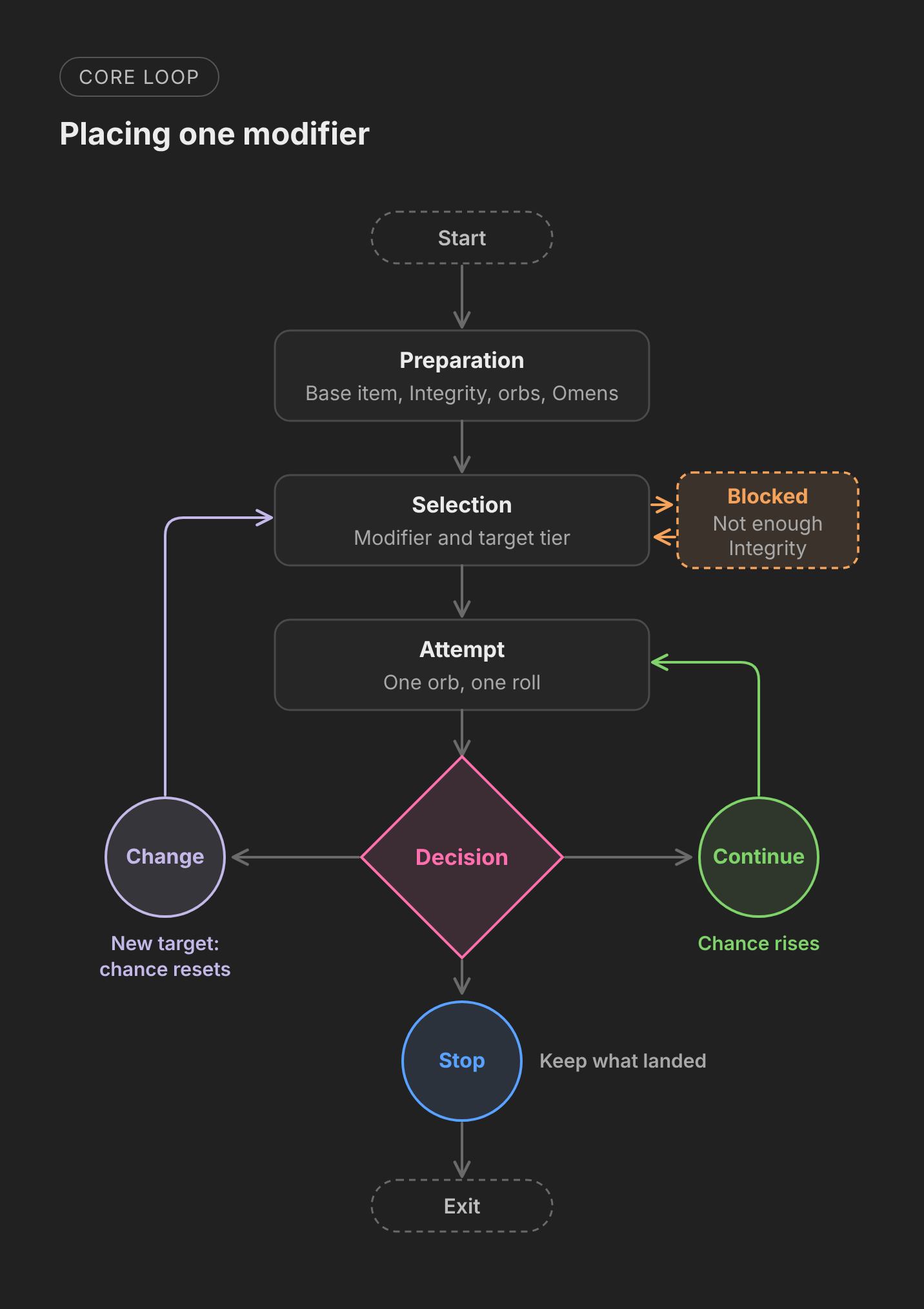
This is the cycle I designed for adding one modifier to an item, the main way players make their gear stronger.
It follows the same four steps as crafting in patch 0.5, so the differences are easy to spot.
Every other system on this page plugs into one of these steps.
Preparation: Players plan the craft before spending anything. They pick a base item, check its Integrity (how much room it has left for new modifiers), then gather the orbs and Omens they need.
Selection: Players choose the exact modifier they want, plus a target tier: the strongest tier they are aiming for. That choice sets which orb each attempt costs. It also sets how much Integrity the modifier will take.
Attempt: Each attempt spends one orb to place the modifier on the item. The modifier lands either on the target tier, a hit, or on a weaker tier, a miss. A miss makes the next attempt more likely to hit, while a hit starts the odds over.
Decision: Players keep going, aim at a different target, or stop with what landed. Changing the target also resets the improved odds, so switching always has a cost.
Net effect
Players walk away with a modifier they chose themselves, on an item whose Integrity set how far it could go. Unlike in 0.5, no failed attempt is wasted, because each one brings the next hit closer.
Crafting Mechanics
Modifier and Tier Selection
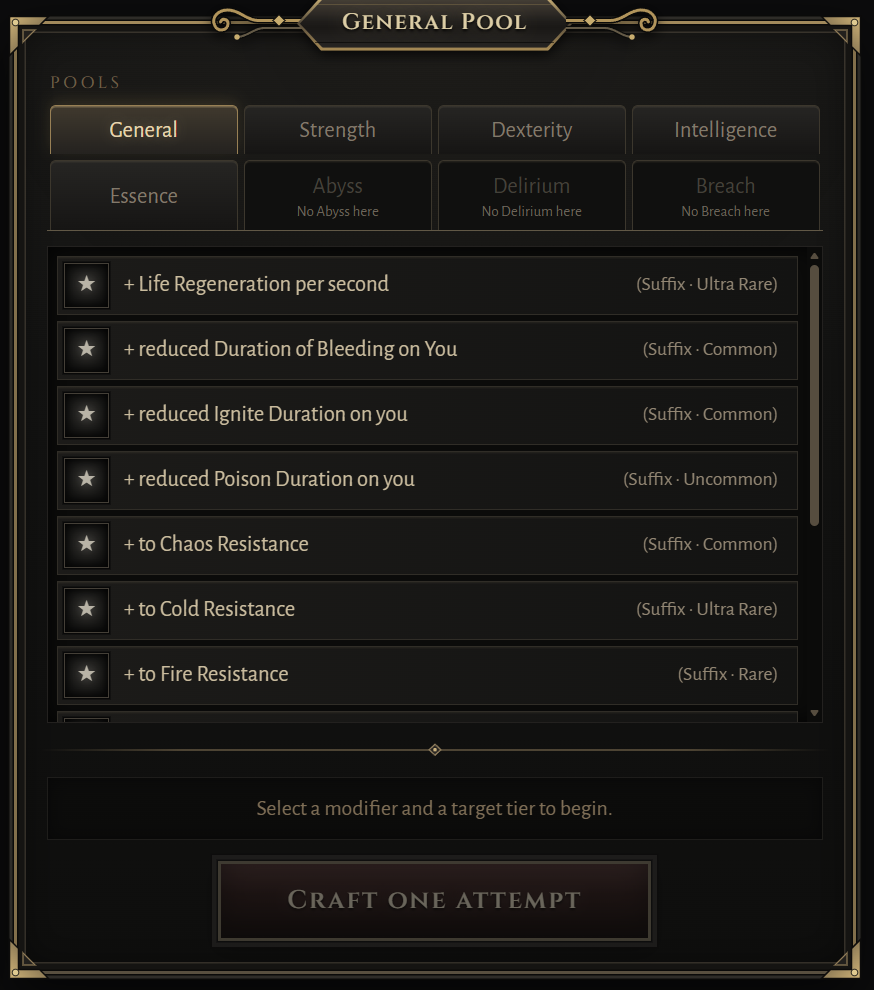
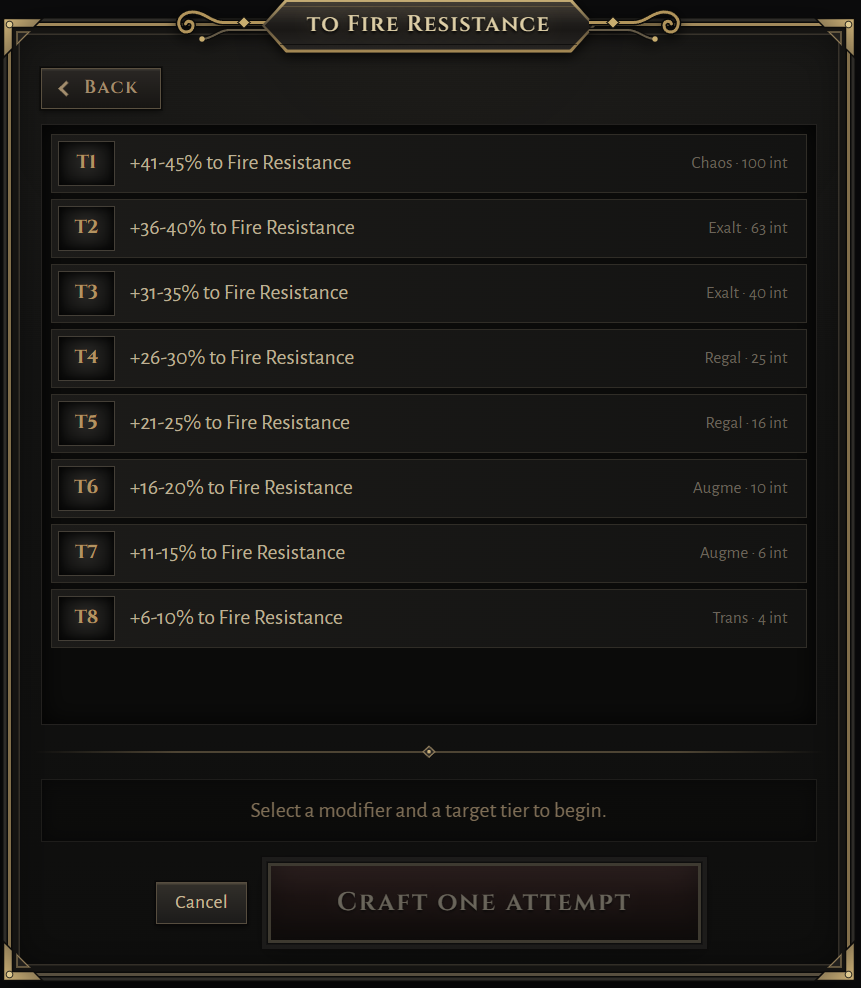
Modifier
Every craft starts with two choices, and the first is the modifier.
Each base item has its own list of possible modifiers: a body armour offers a different list from an amulet. Modifier pools, covered later in this chapter, decide what each list contains.
Target tier
The second choice is the target tier.
Any tier is open, as long as the item level allows it. Fire Resistance on a body armour has 8 tiers, and Tier 1 needs item level 82.
Ceiling rule
- The target tier works as a ceiling: an attempt lands on that tier or a weaker one.
- Aiming at Tier 4 gives a result anywhere between Tier 4 and Tier 8.
- The stronger the target tier, the rarer the orb it takes, with Tier 1 asking for the rarest of all
Value roll
- Each tier covers a range of values. Tier 1 Fire Resistance rolls between +41% and +45%.
- The exact value inside that range is picked at random once the tier lands.
Pseudo-random Distribution
Each attempt spends one orb to land on a tier between the target and the weakest one.
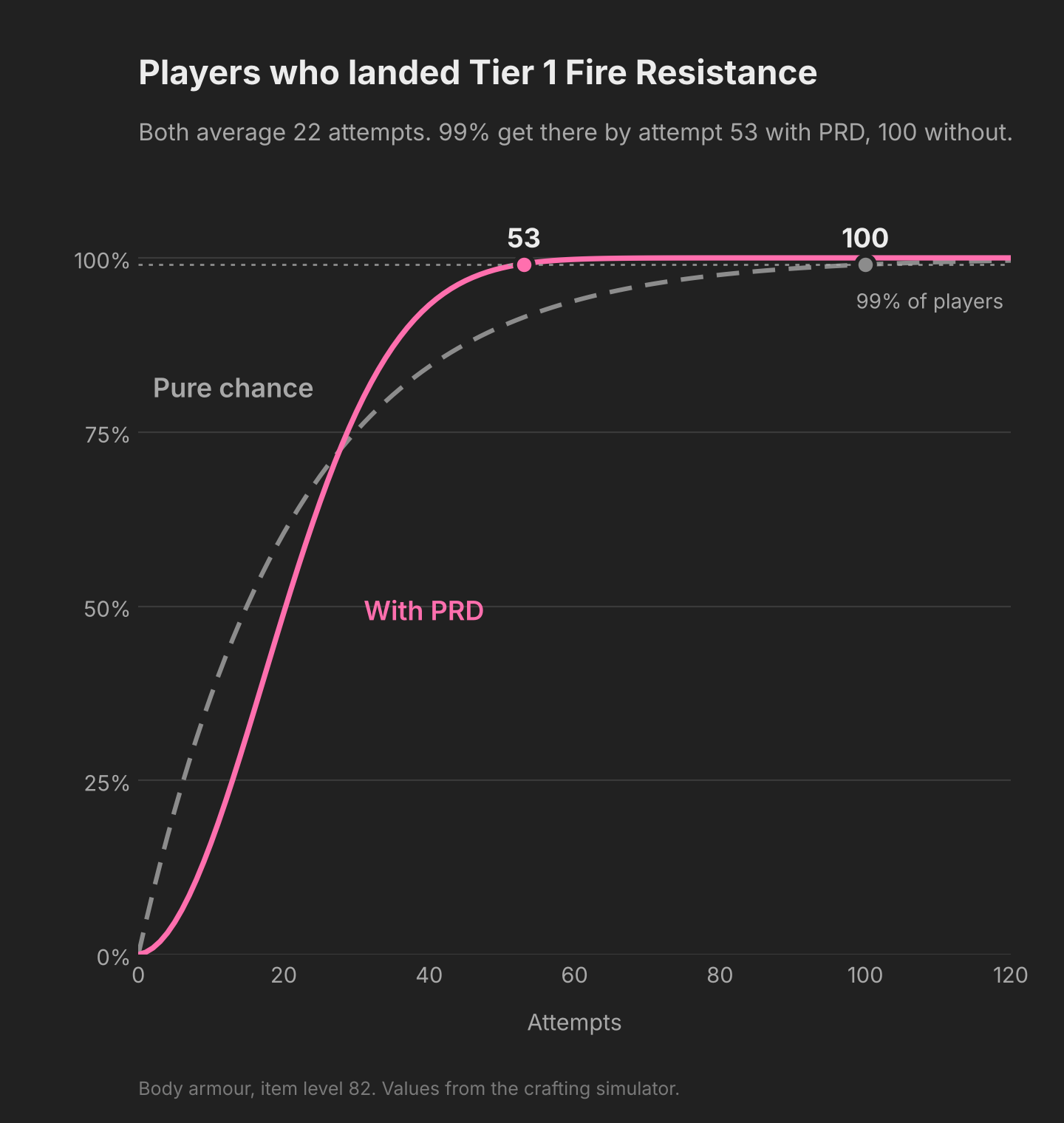
Pseudo-random distribution, a technique Dota 2 uses for critical strikes, makes every miss raise the chance of a hit on the next attempt.
A safety net for bad luck
- The first attempt starts below the tier’s normal chance, then climbs with every miss until a hit resets it.
- On average, players need the same number of attempts as with pure chance. Only the spread changes. Very lucky early hits become rarer, while long bad streaks get cut off.
- In the simulator, Tier 1 Fire Resistance takes about 22 attempts on average either way. Under pure chance, the unluckiest 1% of players need about 100, while this system brings them down to about 53.
Progress belongs to the item
- Progress is saved on the item, tied to the modifier and target tier being attempted.
- Switching either one resets it, so progress built on a cheap target cannot carry over to an expensive one.
- Since each item keeps its own progress, a craft can be paused and picked up later without losing anything.
Effect on the player
- Every miss brings the next hit closer, letting effort add up across attempts.
- Hidden progress keeps each hit a surprise. Hiding it also keeps players from reading the curve to plan around it.
Currency Brackets
Some orbs are much rarer than others.
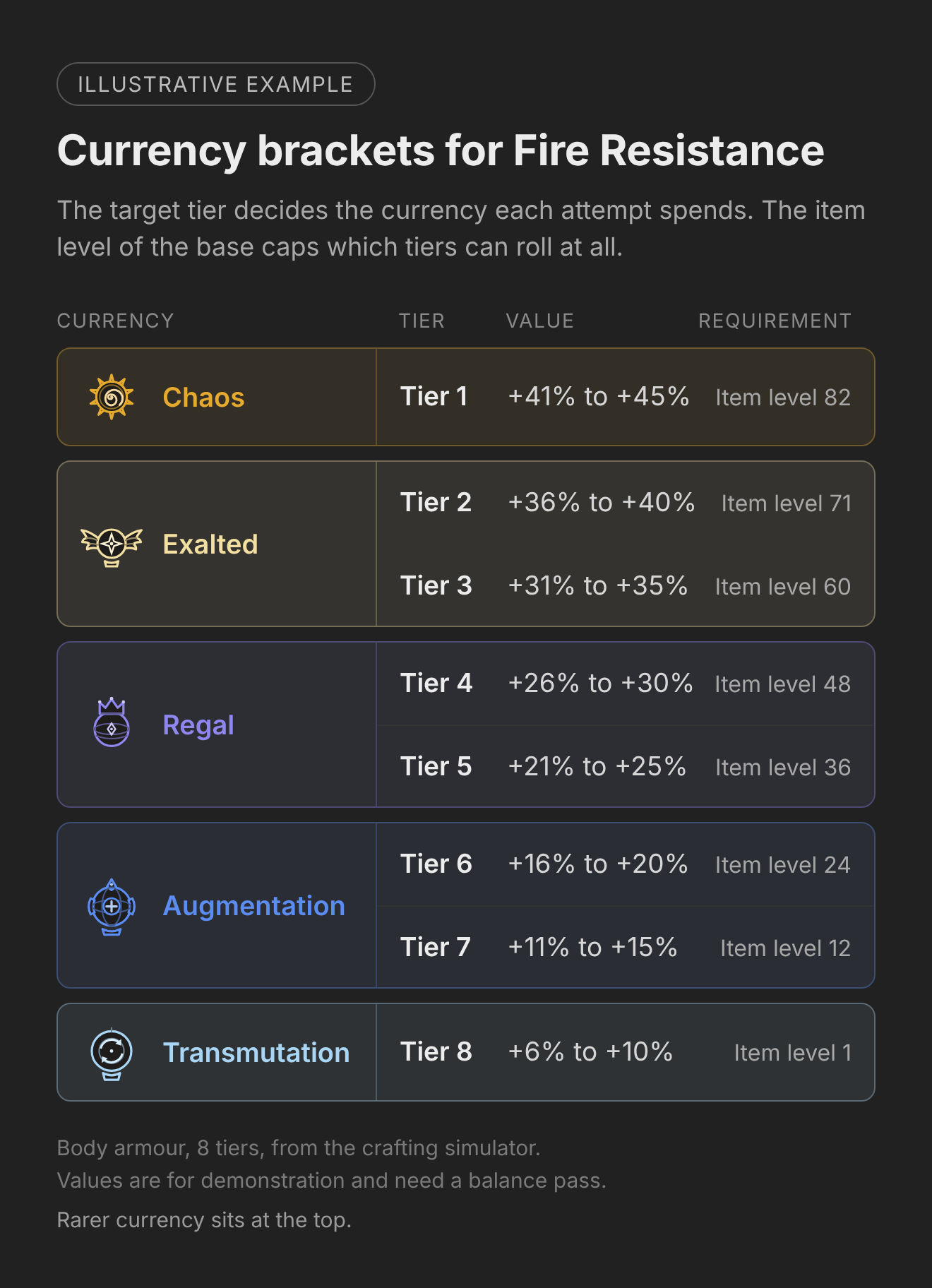
In my design, the target tier decides which orb each attempt spends. Higher targets call for rarer orbs.
Brackets by position
- Brackets are set by where a tier sits among all tiers of its modifier, from Tier 1 down to the weakest.
- One rule then covers a modifier with 8 tiers just as well as one with 15.
Fire Resistance on a body armour (8 tiers), from most common orb to rarest:
- Transmutation Orb: Tier 8
- Augmentation Orb: Tiers 6 and 7
- Regal Orb: Tiers 4 and 5
- Exalted Orb: Tiers 2 and 3
- Chaos Orb: Tier 1
What brackets do
- They gate the top tiers. Only a Chaos Orb reaches Tier 1, however many Transmutation Orbs a player holds.
- No separate price rule is needed, since aiming higher already costs a rarer orb.
Item level as a second gate
- Item level also caps which tiers can roll. Tier 1 Fire Resistance needs item level 82, while Tier 2 needs 71.
- A high target needs both an orb that reaches the tier and a base item whose level allows it.
- High-level base items are rare drops, which keeps finding a good one important for crafting.
Integrity
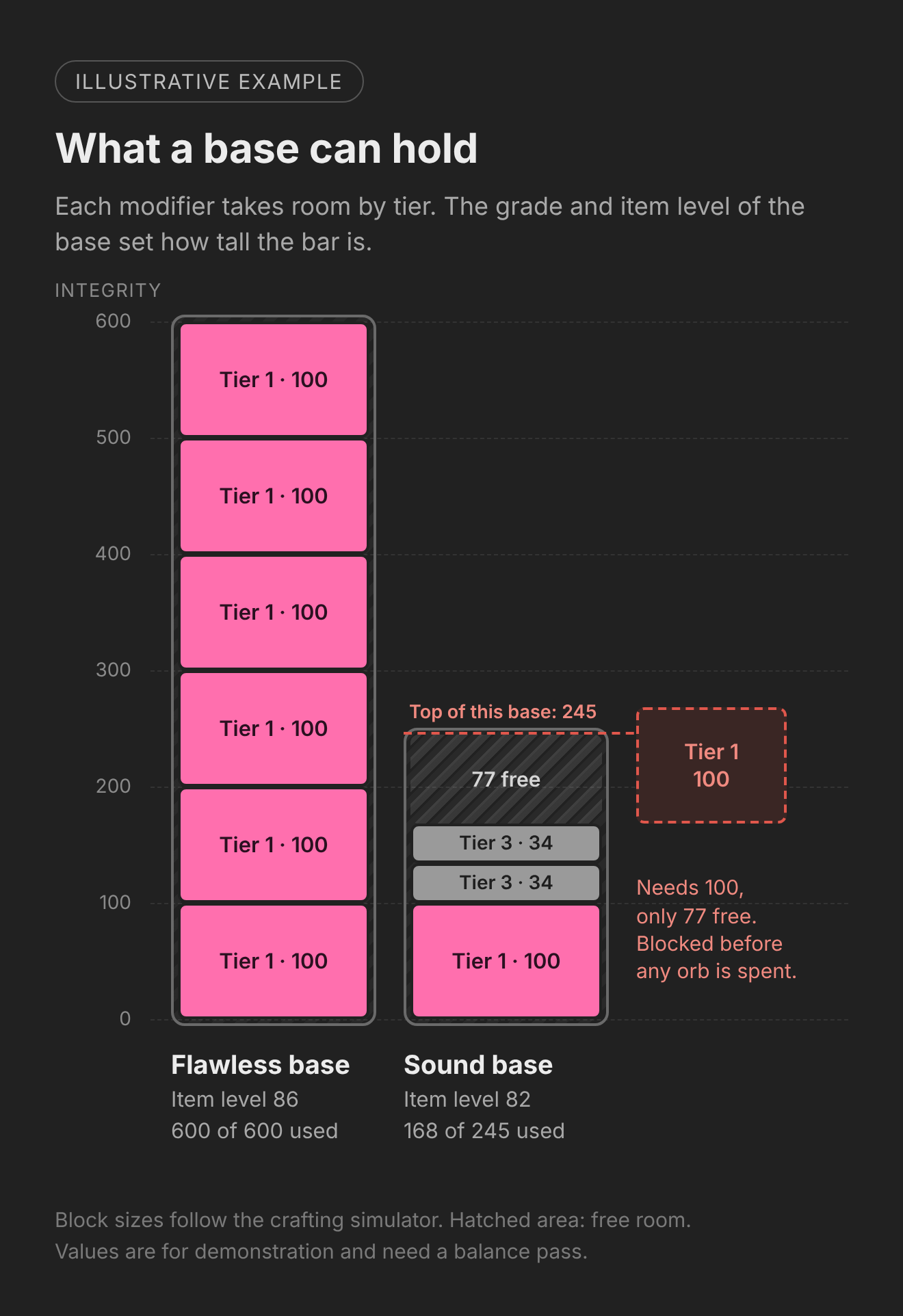
Every modifier uses part of an item’s Integrity until nothing else fits.
This limit decides how strong an item can get.
Grades
- Each item rolls its Integrity when it drops, in one of six grades from Cracked up to Flawless.
- Better grades are rarer drops, with Flawless as the rarest.
- Integrity is visible before any craft, letting players judge a base item before spending anything on it.
How modifiers use it
- Each modifier takes a share of Integrity for as long as it stays on the item.
- Rarer tiers take more room: a Tier 1 modifier uses many times the share of a low tier.
- Every craft becomes a question of what fits together.
Blocking rule
- A craft that would not fit in the remaining Integrity is blocked before it starts.
- The screen explains why before any orb is spent.
- Strong modifiers placed early can leave room for only a low tier at the end, which makes the order of a craft matter.
Effect on the top end
- Only a Flawless item can hold a full set of Tier 1 modifiers.
- More common grades fit a couple of Tier 1 modifiers next to lower tiers. Every item ends up with a clear limit.
- Since the strongest items depend on what players find, dropped items stay valuable. A high-Integrity base item becomes a goal of its own.
Modifier Pools
A modifier pool is a group of modifiers that share one source and one rule.
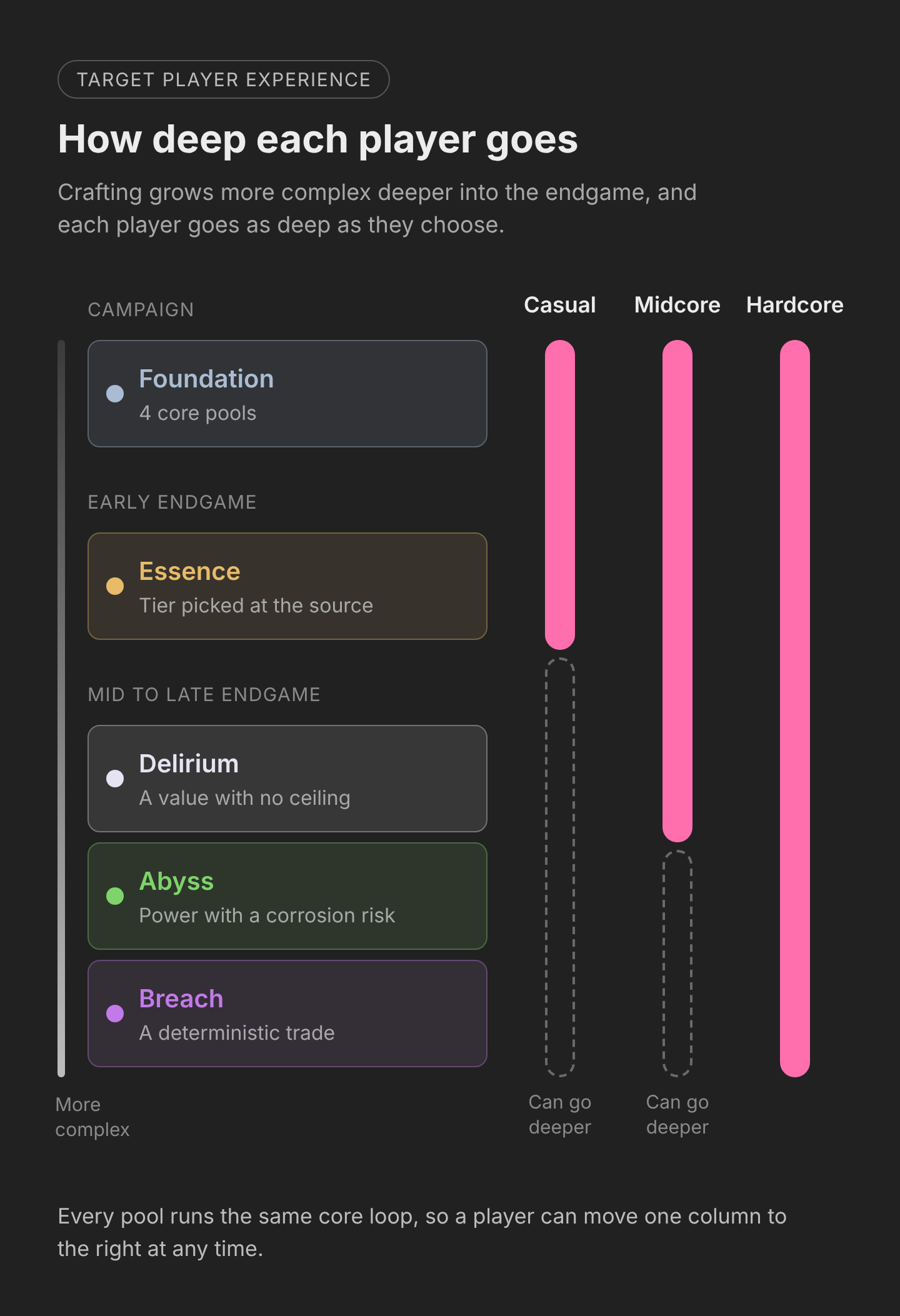
My design has 8 pools that open in stages: crafting starts simple and gains depth as players progress.
When each pool opens
- Foundation covers the campaign, the story portion of Path of Exile 2. Its 4 pools hold modifiers that already exist today, giving every player a shared starting point.
- Essence opens early in the endgame, which starts once the campaign ends. It brings modifiers found only in its pool, each with a fixed tier.
- Abyss, Delirium and Breach arrive later in the endgame. Each adds its own risk or trade: a corrosion risk, a value with no ceiling, or a sacrifice.
From new players to veterans
- New players can craft with Foundation alone and still progress.
- Each later pool is optional, so complexity grows only as fast as players choose.
- Every pool follows the same crafting loop. Each new one starts from rules players already know.
Each pool and its mechanics are detailed below.
Foundation
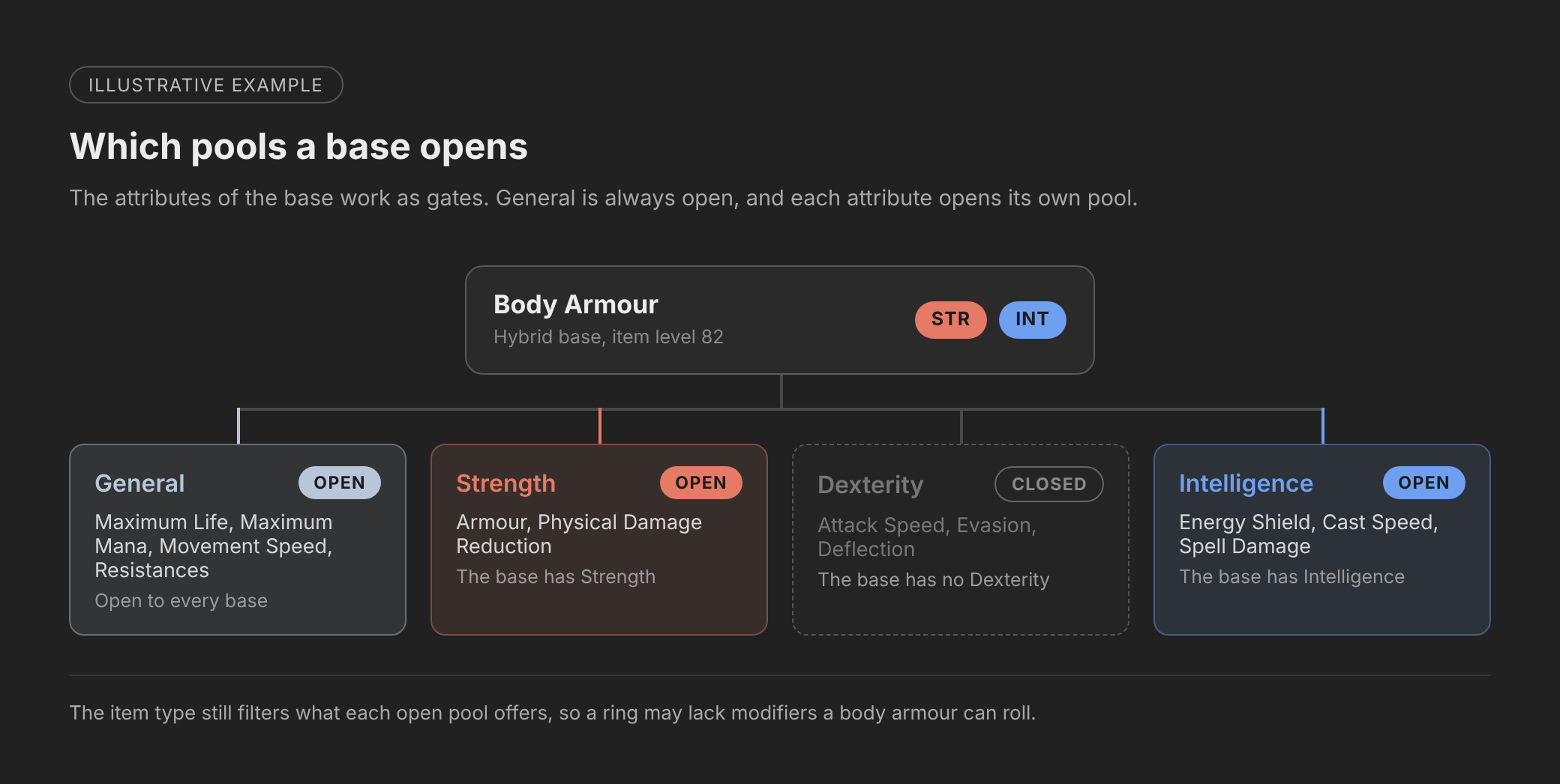
Foundation is made of four pools: General, Strength, Dexterity and Intelligence. Together they hold 139 modifiers that already exist in the game, spread across 26 item types. They use the orbs and brackets described earlier, with no extra rules.
- This is where every player starts crafting, and it is designed to cover about 90% of what players craft during the campaign.
- Every other pool comes later, once these rules feel familiar.
Which pools a base item opens
Most base items in Path of Exile 2 are tied to one or two attributes: Strength, Dexterity or Intelligence. Those attributes decide which pools a base item can craft from.
- General: Maximum Life, Maximum Mana, Movement Speed and Resistances. Open to every base item.
- Strength: Armour and Physical Damage Reduction. Open to Strength base items.
- Dexterity: Attack Speed, Evasion and Deflection. Open to Dexterity base items.
- Intelligence: Energy Shield, Cast Speed and Spell Damage. Open to Intelligence base items.
Two extra rules
- Base items tied to two attributes open both of their pools. A body armour tied to Strength and Intelligence, for example, crafts from three pools at once, General included.
- Item type adds a second filter. Movement Speed belongs to General but rolls on boots alone.
Essence
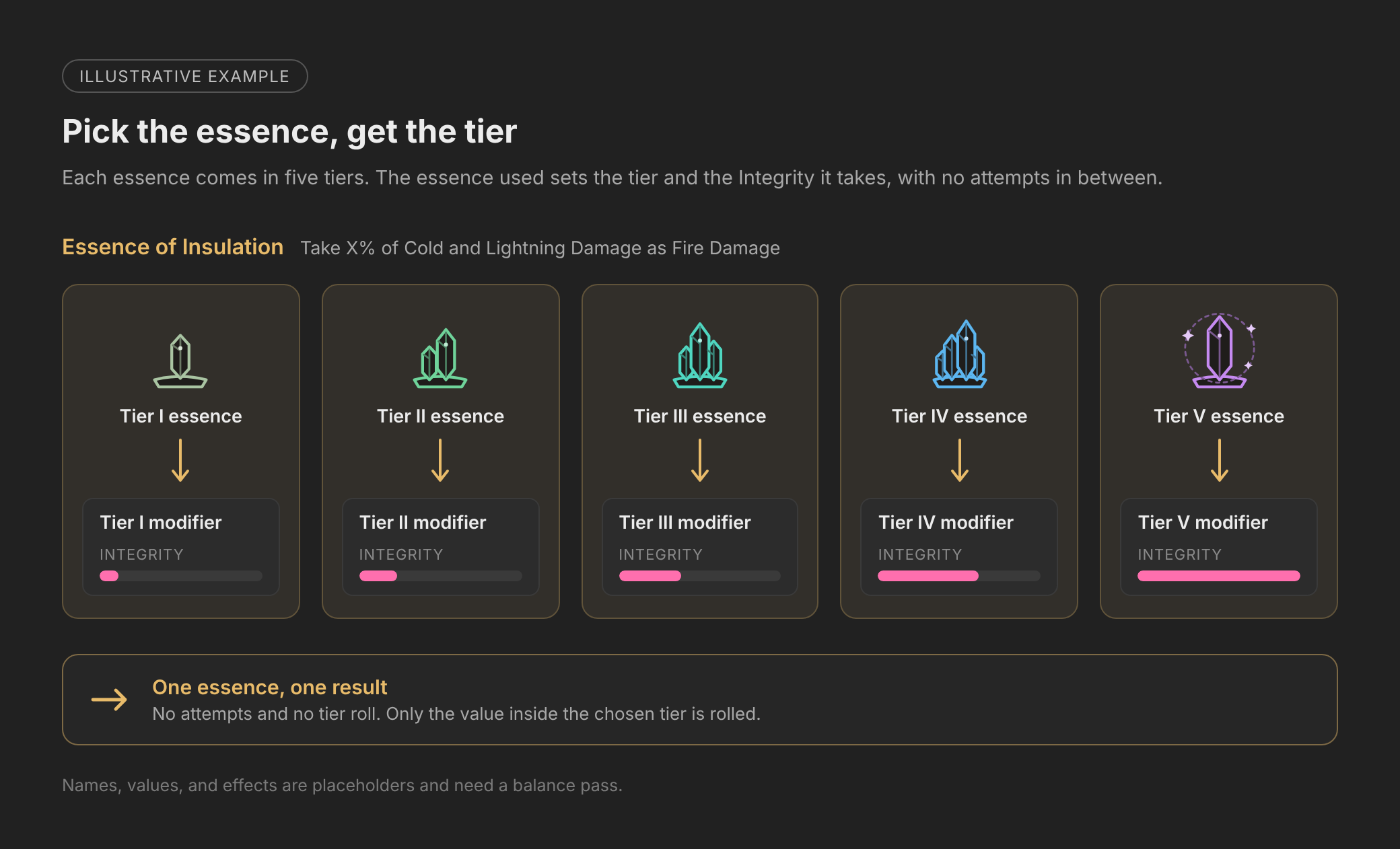
Essences are currency items that each add one specific modifier to an item. They are the first new crafting tool players meet in the endgame, after a campaign spent only on Foundation. There are 22 essences, each tied to its own modifier.
What makes Essence different
- Exclusive modifiers: each essence is themed after a familiar play style, with an effect no Foundation pool carries. One example takes part of incoming Cold and Lightning damage as Fire damage.
- Own currency: Essence modifiers come only from essences, outside the orb brackets.
- One per item: an item can hold a single Essence modifier.
- Fixed tier: essences come in 5 tiers, from I to V. Each one sets its own tier along with the Integrity it takes. With no roll involved, players know the result as soon as they pick it.
Tuning note
- Since the result is guaranteed, essences should drop less often to keep the guarantee worth its cost.
- If that rarity stops Essence from working as the entry to endgame crafting, there is a fallback. Essences would move to pseudo-random distribution and drop far more often, trading certainty for volume.
The modifiers below show the design. Names, values and effects are placeholders, open to rebalancing after testing.
Essence modifiers ▾
| Essence | Slot | Effect |
|---|---|---|
| Essence of Flames | Weapon | Gain X% of damage as Extra Fire Damage |
| Essence of Ice | Weapon | Gain X% of damage as Extra Cold Damage |
| Essence of Electricity | Weapon | Gain X% of damage as Extra Lightning Damage |
| Essence of Abrasion | Martial Weapon | Gain X% of damage as Extra Physical Damage |
| Essence of Insulation | Any Armour | Take X% of Cold and Lightning Damage as Fire Damage |
| Essence of Thawning | Any Armour | Take X% of Fire and Lightning Damage as Cold Damage |
| Essence of Grounding | Any Armour | Take X% of Fire and Cold Damage as Lightning Damage |
| Essence of Ruin | Body Armour | Take X% of Elemental Damage as Chaos Damage |
| Essence of Chaos | Body Armour | Convert X% of Physical Damage taken as Chaos Damage |
| Essence of Mana | Body Armour | X% of damage is taken from Mana before Life |
| Essence of Blood | Any Armour | Convert X% of Mana Cost of skills into Life Cost |
| Essence of Seeking | Any Armour | Hits against you have X% Reduced Critical Damage Bonus |
| Essence of Command | Sceptre | Decreases Command skill Cooldown by X% |
| Essence of Sorcery | Magic Weapon | Gain X% Spell Damage per XXX of Current Mana |
| Essence of Casting | Magic Weapon | Gain X% Cast Speed per XXX of Current Mana |
| Essence of Haste | Martial Weapon | X% chance to gain Onslaught on Killing Hits with this weapon |
| Essence of Alacrity | Belt | X% Increased Mana Cost Efficiency |
| Essence of Agility | Boots | Gain X% Movement Speed if you have Deflected recently |
| Essence of Bashing | Shield | Gain X% Stun buildup on enemies per XX Block Chance (local) |
| Essence of Shielding | Shield | Gain X% Block Chance per XXX Armour (local) |
| Essence of Infinite | Amulet | X% Increased to Strength, Dexterity, and Intelligence |
| Essence of Horror | Belt | Convert X% of all damage done and received to Chaos Damage |
Abyss
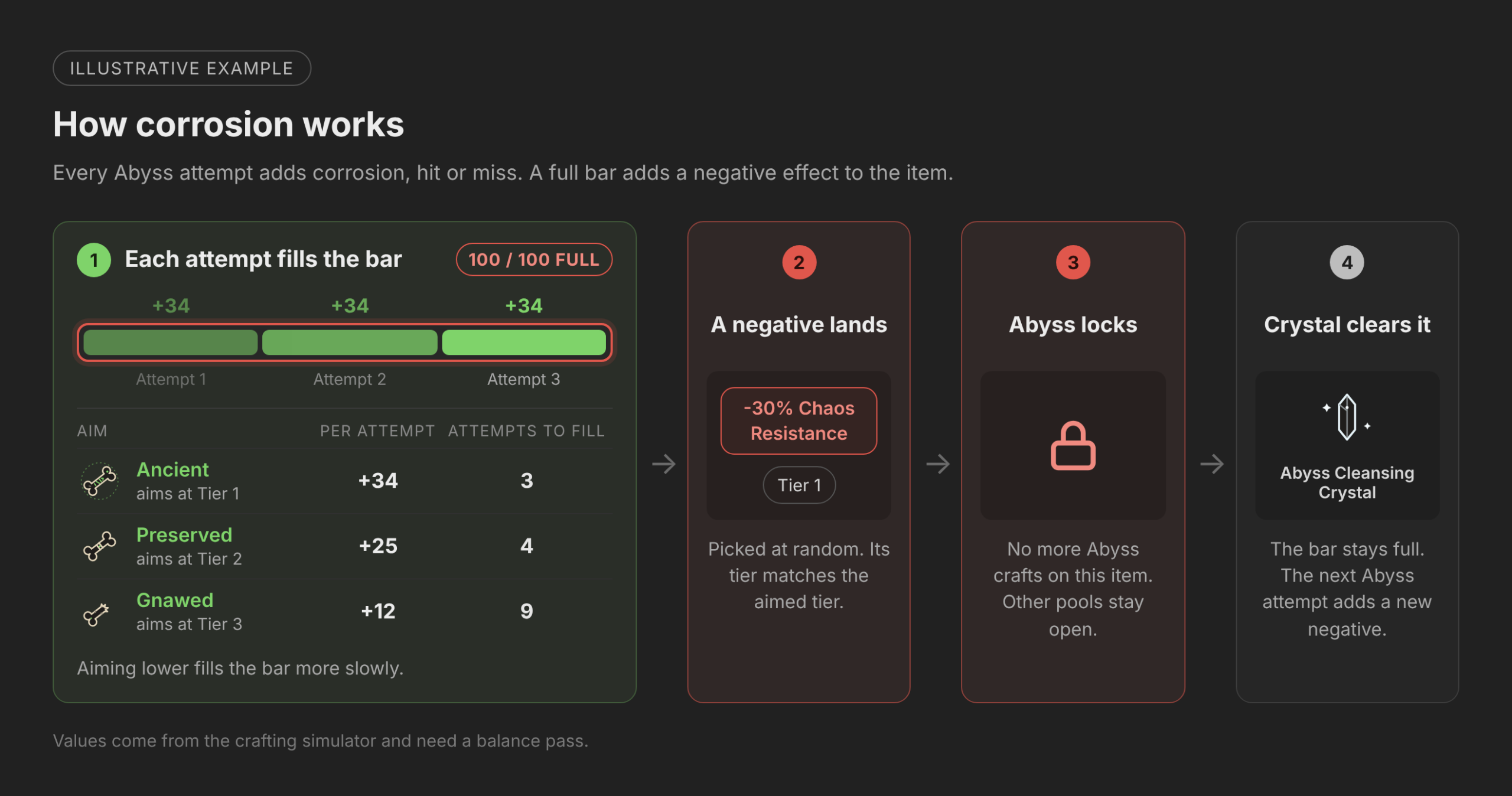
Abyss holds high-end modifiers themed around Chaos damage and the Abyssal Lords from the game’s lore. It is the first pool where players take on risk by choice. Every Abyss attempt adds corrosion to the item, a growing danger that higher tiers raise faster.
Tiers and risk
- Abyss modifiers come in 3 tiers, with Tier 3 as the entry point and light on corrosion.
- Tiers 2 and 1 raise power along with corrosion, so the best version carries the most danger.
Corrosion bar
- Corrosion fills a bar on the item, and that bar measures the risk.
- It works apart from Integrity. Integrity limits the whole item, while corrosion only limits Abyss crafting.
- The bar never shrinks, even when modifiers change.
Currency and attempts
- Each tier has its own currency, gated by item level and kept outside the orb brackets: Gnawed for Tier 3, Preserved for Tier 2 and Ancient for Tier 1.
- Attempts use pseudo-random distribution, with each miss raising the chance of the next hit.
When the bar fills
- The item gains one of 8 negative effects at random, next to the crafted modifier.
- Each negative effect has 3 tiers and follows the tier players aimed for, even if a weaker tier landed.
- While a negative effect is active, the item cannot take more Abyss modifiers until an Abyss Cleansing Crystal clears it. All other crafting stays open.
Tuning the limit
- Together, the corrosion bar and the Cleansing Crystal decide how many Abyss modifiers an item can hold in practice.
- Three values set that limit: how fast the bar fills, how much each tier adds and what the Crystal restores. Testing decides whether it lands at one modifier, two or more.
- Since the limit comes from tuning, it can move without any rule changing.
Open design decision
Whether the Cleansing Crystal empties the bar too remains open, because each answer leads to a different game. The simulator has a setting for each option and defaults to clearing the negative effect alone.
- If the Crystal clears the bar too, a base item survives bad luck. Players cleanse it, then keep crafting on the same item.
- Clearing the negative effect alone leaves a full bar, so the next Abyss craft triggers a new negative effect at once.
The modifiers below show the design. Names, values and effects are placeholders, open to rebalancing after testing.
Abyss modifiers ▾
| Slot | Effect |
|---|---|
| Martial Weapon | Gain +X Attack Speed per uncapped Chaos Resistance |
| Martial Weapon | Convert X% of Physical Attack Damage to Chaos Damage |
| Martial Weapon | Adds +X to +X Chaos Damage to attacks |
| Caster Weapon | Gain +X% of Physical Damage as Chaos Damage |
| Caster Weapon | Gain +X% Cast Speed and +X% Chaos Damage |
| Caster Weapon | Gain +X% Physical Damage and +X% Chaos Damage |
| Caster Weapon | Increased +X% Chaos Damage |
| Ring | +X% increased Curse Magnitudes |
| Ring | +X% Offering buff effect |
| Ring | Convert +X% of Mana Cost to Life |
| Ring | Increased +X% Chaos Damage |
| Belt | Creates an Abyss clone of the totem cast. The Abyss totem converts all damage to Chaos and applies Abyssal Wasting. Limited to one Abyss totem. |
| Belt | Totems summoned are influenced by Abyss, converting X% of damage to Chaos and applying Abyssal Wasting on hit |
| Belt | Increase effect and duration of Warcries by X%. Convert X% of Attack Damage to Chaos. |
| Belt | Player gains the Mark of the Abyssal Lord. Every 5 seconds, drops a puddle of Plague Disease lasting 10 seconds, dealing X Chaos Damage per second to everyone inside. Mark of the Abyssal Lord: gain one random Abyss Monster Modifier every 10 seconds. |
| Amulet | +X% Chaos Damage |
| Amulet | +X% Chaos Resistance |
| Amulet | +X Spirit per uncapped Chaos Resistance |
| Amulet | +X Life per uncapped Chaos Resistance |
| Reduces all Elemental Resistances by X% |
| Reduces Chaos Resistance by X% |
| Reduces global Evasion by X% |
| Reduces global Armour by X% |
| Reduces global Life by X% |
| Reduces global Energy Shield by X% |
| Reduces global Spirit by X% |
| Reduces the item's Quality by X |
Delirium
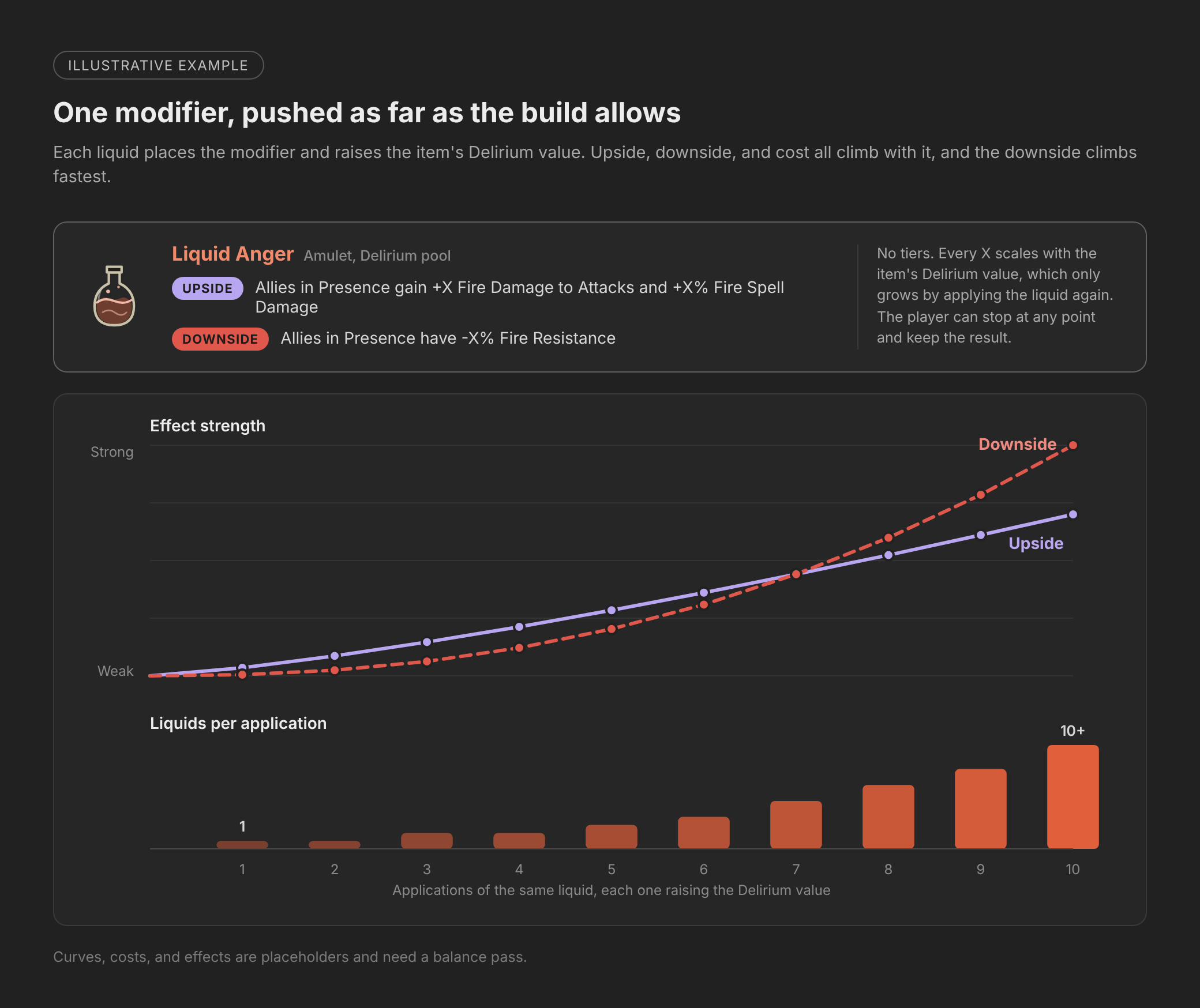
Delirium modifiers are themed around Delirium, a fog of madness in Path of Exile 2, and the Distilled Emotions it leaves behind. As the only pool with no upper limit, Delirium lets players push a modifier as far as their character can handle the drawback.
- It adds 10 modifiers for amulets and belts, in a separate pool.
- Distilled Emotions keep their current uses from patch 0.5 untouched.
How it works
- Delirium modifiers have no tiers. Instead, the item carries a Delirium value, a percentage with no fixed cap that scales both its benefit and drawback.
- An item holds a single Delirium modifier, and applying it again is the only way to raise the value.
- The value lasts as long as the modifier does. An Orb of Annulment, or any other removal, resets the value to zero and frees the slot.
No attempts
- Delirium has no attempts or pseudo-random distribution. Every application places the modifier and raises the Delirium value.
- Players can stop at any point and keep the result, which turns each step into a question: is more power worth a heavier drawback?
Cost and Integrity
- Each Delirium modifier has its own liquid, a currency outside the orb brackets.
- Every application costs more liquid than the last. Early steps cost about one liquid, while late steps cost ten or more.
- A Delirium modifier takes Integrity like any other, so Omens that act on Integrity apply to it too.
Tuning the curves
- The benefit grows at a steady rate, while the drawback speeds up as Delirium climbs.
- Since the drawback outgrows the benefit, pushing far becomes both expensive and dangerous.
- Benefit, drawback and cost each follow their own curve, so testing can tune them apart.
The modifiers below show the design. Names, values and effects are placeholders, open to rebalancing after testing.
Delirium modifiers ▾
| Liquid | Upside | Downside |
|---|---|---|
| Liquid Anger | Allocates Anger. Allies in Presence gain +X Fire Damage to Attacks and +X% Fire Spell Damage. | Allies in Presence have -X% Fire Resistance. |
| Liquid Hatred | Allocates Hatred. Allies in Presence gain +X Cold Damage to Attacks and +X% Cold Spell Damage. | Allies in Presence have -X% Cold Resistance. |
| Liquid Wrath | Allocates Wrath. Allies in Presence gain +X Lightning Damage to Attacks and +X% Lightning Spell Damage. | Allies in Presence have -X% Lightning Resistance. |
| Liquid Mindfulness | Allocates Discipline. Allies in Presence gain +X% Mana Regeneration. | Allies in Presence have -X% Energy Shield Recharge Speed and Delay. |
| Liquid Focus | Allocates Elements. Allies in Presence gain +X% to all Elemental Resistances. | Allies in Presence have -X% Chaos Resistance. |
| Liquid Vitality | Allocates Vitality. Allies in Presence gain +X Life Regeneration. | Allies in Presence take +X% Physical Damage. |
| Liquid | Effect | Detail |
|---|---|---|
| Liquid Delirium | You and your allies gain one stack of Mad per normal and magic monster kill, up to XX, each lasting XX seconds. | Per XX stacks of Mad: gain X Attack Speed, X Attack Damage, and X Chaos Damage. Take XXX true damage per second per stack. |
| Liquid Insanity | Player is Insane. Every 5 seconds, hit yourself in confusion, applying X stacks of corrupted bleeding to yourself. | Insane: gain one random Delirium Monster Modifier every X seconds. |
| Liquid Depression | Player is Depressed. Every 5 seconds, take XXX Physical Damage. | Depressed: increase all Damage over Time and its Duration by X%. |
| Liquid Happiness | Player is Happy. Every 5 seconds, take XXX Elemental Damage. | Happy: increase action skill and movement speed by +X%. |
Breach
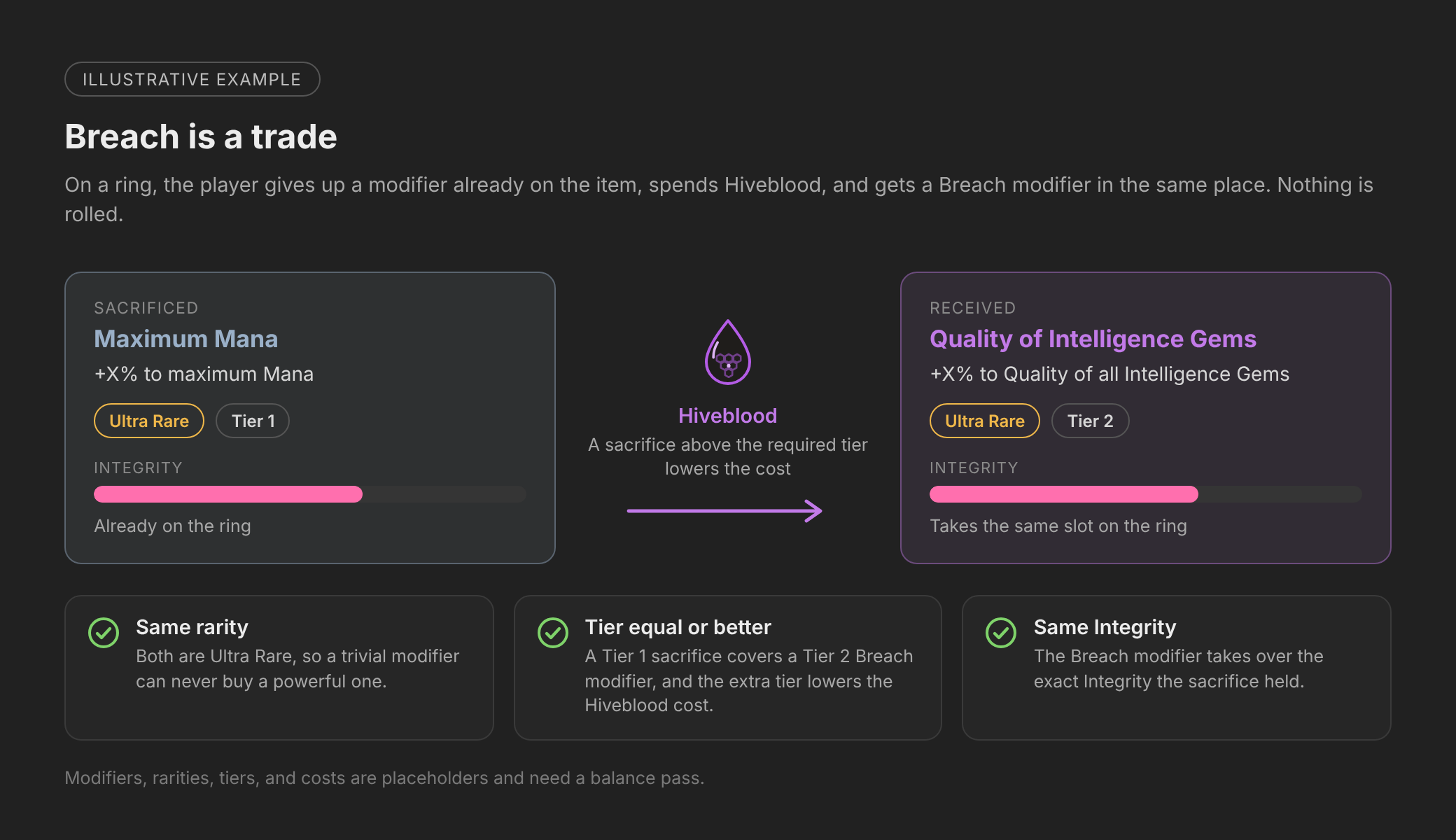
Breach modifiers grant quality, a bonus that raises the stats of an item or a skill gem, to other gear or to gems. Skill gems are what give characters their abilities. This sets Breach apart, since every other pool only improves the item it sits on.
- It adds 14 modifiers for rings, amulets and belts. Its theme and jewellery focus come from patch 0.5, while the crafting mechanic is new.
- The theme draws on Chayula’s Pact, in which a god of Breach grants power in exchange for something of equal worth. Building the pool around one god leaves room to add others later, each with its own content.
An exchange
- Players sacrifice a modifier already on the item and spend Hiveblood, the Breach currency. A Breach modifier then takes its place.
- With no attempts or pseudo-random distribution, every trade has a known result.
- A Breach modifier inherits the exact Integrity of the one it replaces, so no Integrity is spent.
How rarity decides the trade
- Every modifier in the game already has a hidden rarity. Some, such as Spirit, a stat that powers ongoing skills, are far rarer than others. Breach turns that hidden layer into the rule of the trade.
- Rarity belongs to the modifier and works apart from its tier, on four levels: Ultra Rare, Rare, Uncommon and Common.
- A sacrifice must match the Breach modifier’s rarity, at the same tier or a better one. The rarest Breach modifiers only come in a few top tiers, so the best results always cost a strong modifier.
Cost
- Every Breach trade spends Hiveblood alongside the sacrifice. Hiveblood comes from the Breach update in patch 0.4.
- Higher Breach tiers cost more Hiveblood. Offering a sacrifice above the required tier lowers that cost, so players short on Hiveblood can pay with a stronger modifier instead.
- Breach Omens can loosen the rule for one trade and accept a sacrifice one rarity or one tier lower.
A note on Catalysts
Catalysts, which add quality to jewellery itself, stay in the game untouched. Breach modifiers grant quality to other items and gems, keeping the two apart.
The modifiers below show the design. Names, values and effects are placeholders, open to rebalancing after testing.
Breach modifiers ▾
| Slot | Effect | Rarity |
|---|---|---|
| Ring | +X% to quality of all Intelligence Gems | Ultra Rare |
| Ring | +X% to quality of all Strength Gems | Ultra Rare |
| Ring | +X% to quality of all Dexterity Gems | Ultra Rare |
| Ring | +X% to quality of Body Armour | Rare |
| Ring | +X% to quality of Helmet | Rare |
| Ring | +X% to quality of Gloves | Rare |
| Ring | +X% to quality of Boots | Rare |
| Amulet | +X% to quality of Martial Weapons | Rare |
| Amulet | +X% to quality of Caster Weapons | Rare |
| Belt | +X% to quality of Rings | Ultra Rare |
| Belt | +X% to quality of Shields | Uncommon |
| Belt | +X% to quality of Foci | Uncommon |
| Belt | +X% to quality of Charms | Common |
| Belt | +X% to quality of Flasks | Common |
Omens
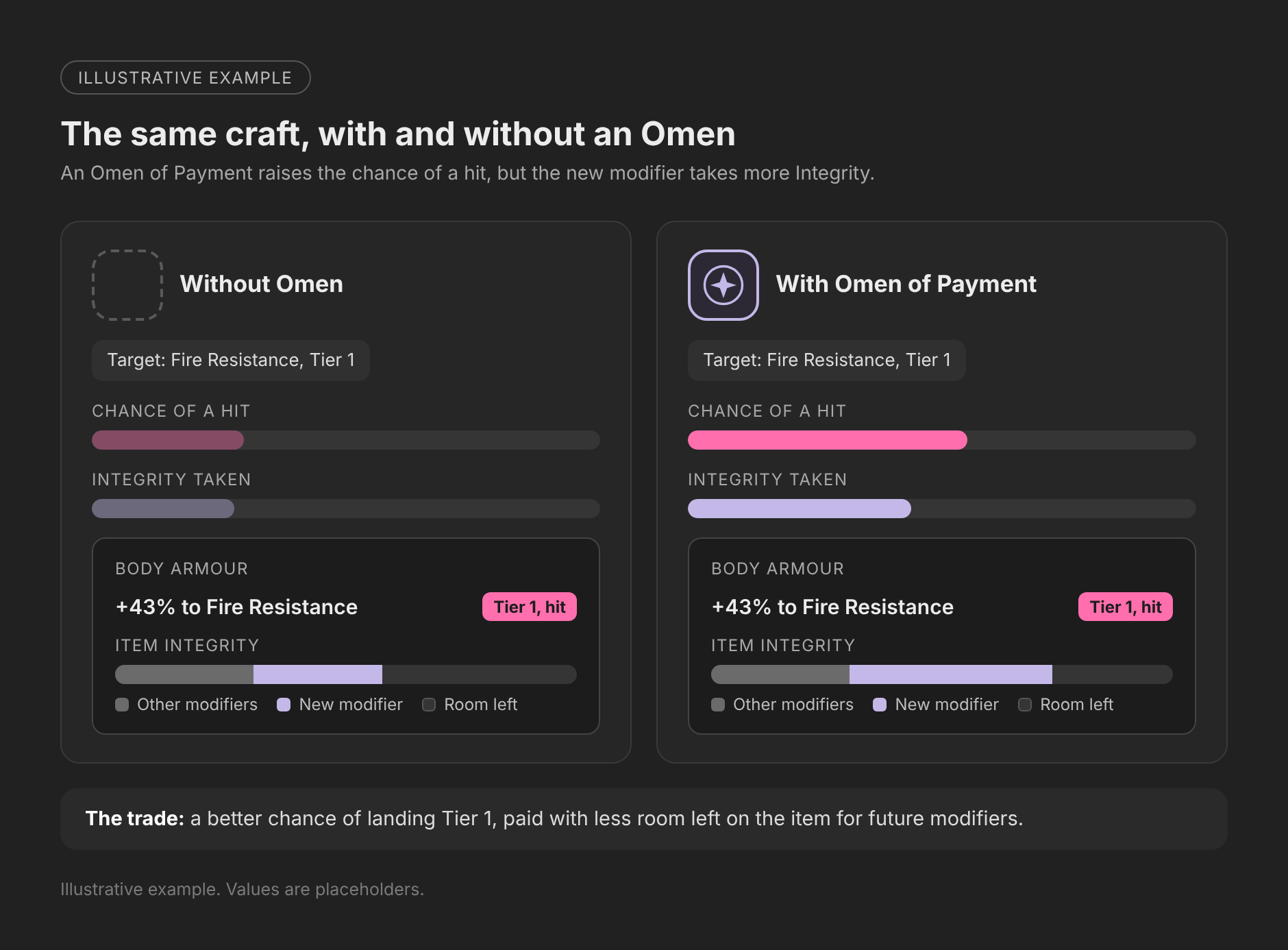
Players gather Omens during Preparation, and each one is spent once its craft happens.
They give players a way to shape risk and chance before spending a single orb.
- 27 Omens across 9 groups cover the odds, Integrity, modifier removal, corruption, fracturing and each of the later pools. Of these, 20 already work in the simulator.
- Like the pools, Omens add to the system without changing its crafting loop.
Each Omen shapes the craft its own way
- Omen of Payment raises the odds of a hit, but the new modifier takes more Integrity.
- Omen of Annulment lets players choose which modifier the next Orb of Annulment removes.
- Omen of Vaal gives the next Vaal Orb a chance to skip corruption, at the cost of all Integrity left on that item. Corruption is a permanent change from a Vaal Orb that locks the item against further crafting.
Omens ▾
| Omen of Strength | Reduces the Integrity cost of your next Strength modifier by X% |
| Omen of Dexterity | Reduces the Integrity cost of your next Dexterity modifier by X% |
| Omen of Intelligence | Reduces the Integrity cost of your next Intelligence modifier by X% |
| Omen of Bounty | Each attempt has an X% chance to recover X Integrity |
| Omen of Payment | Raises the odds of the aimed tier. The crafted modifier costs +X% Integrity |
| Omen of Greed | Raises the odds of the next attempt, with a chance to lose all Integrity |
| Omen of Warrior | Raises the odds of Strength modifiers on the next attempt |
| Omen of Rogue | Raises the odds of Dexterity modifiers on the next attempt |
| Omen of Mage | Raises the odds of Intelligence modifiers on the next attempt |
| Omen of Annulment | The next Annulment lets you choose which modifier to remove. No Integrity is recovered. |
| Omen of Restoration | The next Annulment recovers all the Integrity the removed modifier held |
| Omen of Abyss Corrosion | Reduces the corrosion added on the next Abyss craft |
| Omen of Abyss Dark | Increases the corrosion added on the next Abyss craft |
| Omen of Abyss Light | Chance to turn the next corrosion effect into its positive opposite |
| Omen of Abyss Cleanse | Chance to remove the next corrosion effect, positive or negative |
| Omen of Hiveblood | Reduces the Hiveblood cost of the next Breach craft |
| Omen of Breach Gift | The next Breach accepts a sacrifice one rarity below the requirement |
| Omen of Breach God | The next Breach accepts a sacrifice one tier below the requirement |
| Omen of Divine | The next Divine rolls one modifier's maximum value, raising its Integrity cost |
| Omen of Anti-Divine | The next Divine rolls one modifier's minimum value, lowering its Integrity cost |
| Omen of Gambling | The next Divine randomly shifts each modifier's Integrity cost |
| Omen of Vaal | The next Vaal Orb may not corrupt the item. The item loses all Integrity. |
| Omen of Mirror | The next Mirror does not apply the mirrored tag and recovers part of the Integrity |
Constraints & Edge Cases
Some currencies act around the core loop rather than inside it. They remove, protect, or reveal a modifier, and some act on Integrity while they do.
Each is judged by the same question: how much certainty it can offer without breaking the loop, and what it pays for that power.

Orb of Annulment
In Patch 0.5 it removes a modifier from an item at random.
This is how a player cleans off a result they do not want, and it is a core part of the crafting fantasy.
The random-versus-deterministic trade-off
- Deterministic removal is the stronger tool, since choosing what to strip is real power, so it always needs something to pay for it.
- Version 1 made it deterministic and paid for that with a currency cost that scaled by the removed tier.
- Version 2 dropped tier-based costs, which left deterministic removal as power with nothing paying for it, so it went back to random.
- The other option was to make it rare enough to balance, but that would lock away a tool meant to stay common, so random won.
Version 3 keeps it random and adds Integrity decay.
- The orb returns less Integrity than the removed modifier held, scaled by what was removed.
- The item wears down as it is reworked, so a single base cannot be reused forever.
- It now drains currency and item longevity at once, which the economy needs once the pseudo-random distribution softens the old crafting sink.
Fracturing Orb
In Patch 0.5 it locks one modifier in place on a rare item, so it can never be removed.
- It is a protection tool, shielding a modifier the player wants to keep.
- It needs a rare item with at least four modifiers, and it locks one of them at random.
The random-versus-deterministic trade-off
- Version 1 made crafting almost fully deterministic, which left little randomness to protect against, so the orb was nearly useless.
- Version 2 gave it a job by letting the player choose which modifier to lock, since the orb was too weak to need randomness as a brake.
- Version 3 brought Integrity, which gave the orb a resource to spend, so it returns to a random base effect and turns the choice into a paid option.
Version 3 keeps it random and makes it cost Integrity.
- Locking a modifier costs a portion of that modifier’s Integrity, so protection is not free.
- The cost scales with the locked modifier, so shielding a strong one costs more.
- This keeps it in line with the Annulment: random by default, with determinism paid for separately through an Omen.
- A locked modifier is safe from a later random Annulment, and its Integrity is shielded from that decay.
- Locking the keeper, then annulling to clear the rest, is a deliberate play: the blind removal cannot hit what the player protected.
Hinekora’s Lock
In Patch 0.5 it previews the exact result of the next currency used on an item, before the player commits to it.
- Applying it puts the item into a foreseeing state, and it is spent only if the player goes through with the craft. Declining costs nothing.
- It is one of the rarest items in the game, second only to the Mirror of Kalandra, used on high-value items to avoid a disaster at a critical step.
The trade-off
- Version 1 made crafting near deterministic, so there was little left to foresee, and the Lock had almost no reason to exist.
- Version 2 restored per-attempt randomness, which made previewing meaningful again in principle, but the loop still had no step costly enough to justify spending the second rarest item in the game.
- Version 3 gives the Lock a second effect through Integrity, so it finally earns its rarity.
Version 3 keeps the foresight and adds an Integrity reset.
- It still previews the exact result of the next currency, as it always has.
- Using it also restores the item’s Integrity to full.
- The Lock is rare enough that this reset almost never happens, so the decay sink stays intact in practice, and the effect stays true to the fantasy of reading a craft’s future and making an item whole again.
Key Design Decisions

The decision: keep randomness, but turn it into a dial the player controls, rather than making crafting fully deterministic.
Also considered: fully deterministic crafting (pick it, get it), or keeping today’s pure RNG.
Why: full determinism would tend to hollow out ground loot, since any base could become anything and drops turn into noise. Pure RNG is the original problem. The dial holds both goals that are in tension, player control and loot relevance, instead of sacrificing one for the other.
The decision: the player aims at a tier and lands on that tier or a worse one, not a better one, as general rule.
Also considered: symmetric spillover, where a lucky craft could overshoot into a better tier.
Why: without the ceiling, the cheap exploit is to aim low and pray for a free overshoot. Capping at the target keeps the decision honest, since the player pays for what they aim at.
The decision: a single rule (reference weight divided by item weight) sets the price of modifier rarity, tier rarity, and currency rarity, all pulled from the game’s live Weights. (ARRUMAR)
Also considered: separate, hand-tuned price tables per category.
Why: consistency over exceptions. One rule anchored in real game data instead of invented numbers, and it scales on its own. This is the “depth through elegance” pillar in practice.
Game Design Document
Everything on this page is a summary of the full design.
The full system lives in a design document written as a concept and vision piece. A team would read it to understand the idea, its reasoning and how each system connects.
Reflection
Test